909 packages of meth in a load of leeks: CBP's 1,082-pound Pharr seizure anchors Operation Southern Surge's first results
CDLLife reports the Oct. 30 secondary inspection at the Pharr Port of Entry: a canine alert, cylindrical packages worked into a leek shipment, and 1,082.47 pounds of methamphetamine valued at $984,063. The agencies' own release says the operation since Oct. 19 has seized more than 1,600 pounds of narcotics, 15 firearms and over $360,000, with 89 arrests.
Summarized from CDLLife.
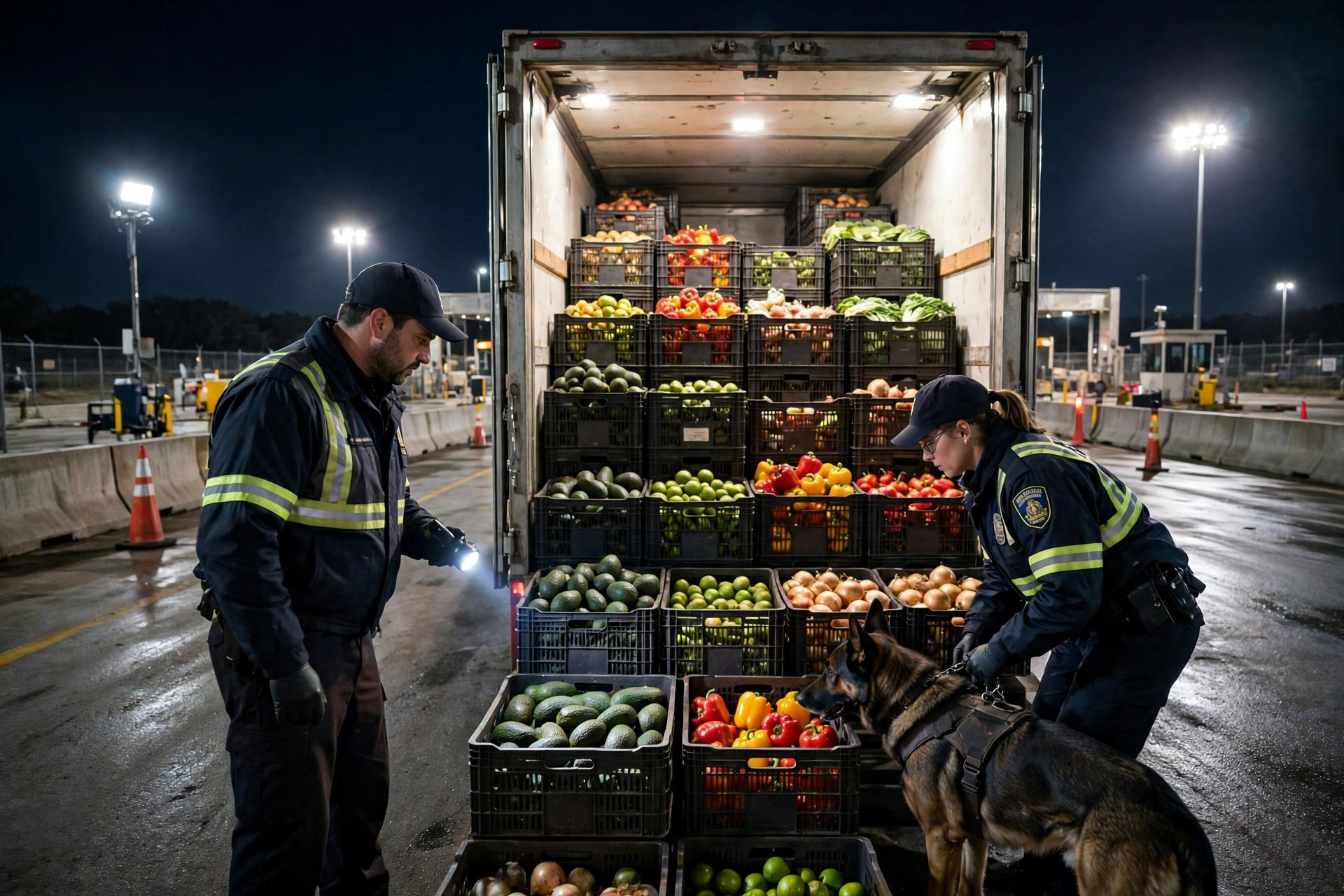
Image: Illustration: AI-generated by CDLWire
U.S. Customs and Border Protection officers seized 1,082.47 pounds of methamphetamine — 909 cylindrical packages hidden among a shipment of leeks — from a semi truck that presented at the Pharr Port of Entry around 8 p.m. on Oct. 30 seeking entry to McAllen, Texas, according to CDLLife on Nov. 4. The seizure, with a street value of $984,063, is the largest single action announced so far under Operation Southern Surge, the multi-agency border operation whose early results were laid out at a Nov. 2 press conference.
The stop itself followed the pattern produce haulers at the Rio Grande Valley ports know well. The truck was referred for a secondary inspection. After a canine unit alerted to the truck, officers discovered the cylindrical packages hidden among the shipment of leeks. The packages tested positive for methamphetamine. The agencies' own Operation Southern Surge release gives the package count — 909 packages — and locates the same action at the Hidalgo Port of Entry, with the same weight and the same street value. CDLLife names the crossing as the Pharr Port of Entry; the release names Hidalgo, and the two accounts do not resolve that naming difference.
The seizure was announced as part of a wider operation, and the wider numbers explain why inspection intensity at the South Texas ports is up. Operation Southern Surge is a coordinated Homeland Security Task Force initiative run by CBP with Homeland Security Investigations, the Drug Enforcement Administration and the U.S. Attorney's Office for the Southern District of Texas, targeting drug trafficking and other cross-border criminal activity. At the Nov. 2 press conference at the Juarez-Lincoln International Bridge, officials said that since Oct. 19 the operation has seized more than 1,600 pounds of narcotics, 15 firearms, more than 3,000 rounds of ammunition and over $360,000 in illicit currency, and that its enforcement actions have led to 89 arrests. In other words, the leek load accounts for roughly two-thirds of the narcotics weight the operation has announced so far. A second highlighted action at the Juarez-Lincoln Bridge used nonintrusive inspection technology to flag an anomaly in a vehicle referred for secondary inspection, and officers discovered 49.3 pounds of cocaine concealed in 20 packages.
The agencies were explicit that the operation is built to change how the ports work day to day, not just to collect seizures. The agencies presented Operation Southern Surge at the Nov. 2 press conference as a coordinated Homeland Security Task Force initiative targeting drug trafficking and other cross-border criminal activity. “International drug trafficking presents a direct threat to U.S. national security, public safety and economic stability,” said Jennifer De La O, director of the Laredo Field Office of the Office of Field Operations. “Operation Southern Surge leverages tactical intelligence and coordinated enforcement actions to dismantle the trafficking infrastructure, intercept illicit supply chains, and bolster situational awareness across the southwest border.” HSI's Charles Kerby, Acting Deputy Special Agent in Charge in Laredo, made the follow-on point: “Securing the border requires more than making seizures or stopping a single smuggling attempt. HSI's role is to follow the evidence, identify the people behind these crimes, and dismantle the organizations moving drugs, weapons, money, and people across the border.”
For legitimate cross-border carriers, none of this requires wrongdoing to cost time. A surge operation of this scale means more secondary referrals, longer waits at the South Texas crossings named in the accounts, including Pharr and Hidalgo, and closer looks at exactly the freight profile the leek load used: fresh produce, manifested as an ordinary food shipment, moving at night. The Oct. 30 truck arrived around 8 p.m.; evening and overnight produce crossings should expect the same screening posture while the operation runs. Drivers cannot control whether their trailer is selected, but they can control the paperwork and the seal discipline that decide how fast a secondary inspection ends: an accurate manifest that matches the load, intact seals with numbers that match the documents, and a driver who knows what is on the trailer and where it was loaded.
The other lesson is about exposure. A load of leeks is the kind of freight produce carriers haul every day without a second thought, and the smuggling method — hundreds of small packages worked into a legitimate food shipment — is designed so that the freight itself looks ordinary on paper. Carriers running the Valley ports should treat pickup verification as part of the job during a surge: confirm the shipper, confirm who loaded and sealed the trailer, photograph the seal at origin, and report any break in that chain before the bridge, not at the secondary lot. The 89 arrests announced with the operation are a reminder that investigations follow the evidence past the port, and the cleanest protection for a carrier whose trailer is used without its knowledge is a documented chain of custody that shows exactly that. Until Southern Surge winds down, build inspection time into Rio Grande Valley and Laredo crossing plans and keep dispatch informed from the secondary lot, not after it.
Sources
Related coverage
 November 1, 2026 · BorderCabotage enforcement is 'really ramping up,' Knight-Swift's CEO warns — as Nuevo León halves the Colombia Bridge truck toll
 October 31, 2026 · BorderOhio will downgrade all 5,000 reviewed non-domiciled CDLs — 2,000 already done — as Louisiana and Wyoming confirm they will never resume issuing
 October 28, 2026 · BorderMexico truckers reach a deal for talks after the strike disrupted 19 states — but no one has confirmed the protests are over
Comments
Loading comments…