Kodiak's first Gen7 Western Star day cabs go driverless in the Permian — and a 75-truck fleet deal queues up behind them
Commercial Carrier Journal reports the first two Western Star 49X trucks with Kodiak's Gen7 system are in commercial service at Atlas Energy Solutions, the first of 65 Western Stars inside a 100-truck order due by mid-2027. TruckingInfo adds DTL Transport's binding 75-truck driver-as-a-service deal and a safety case Kodiak puts at 99% ahead of a driverless Dallas–Houston IKEA launch.
Summarized from Commercial Carrier Journal.
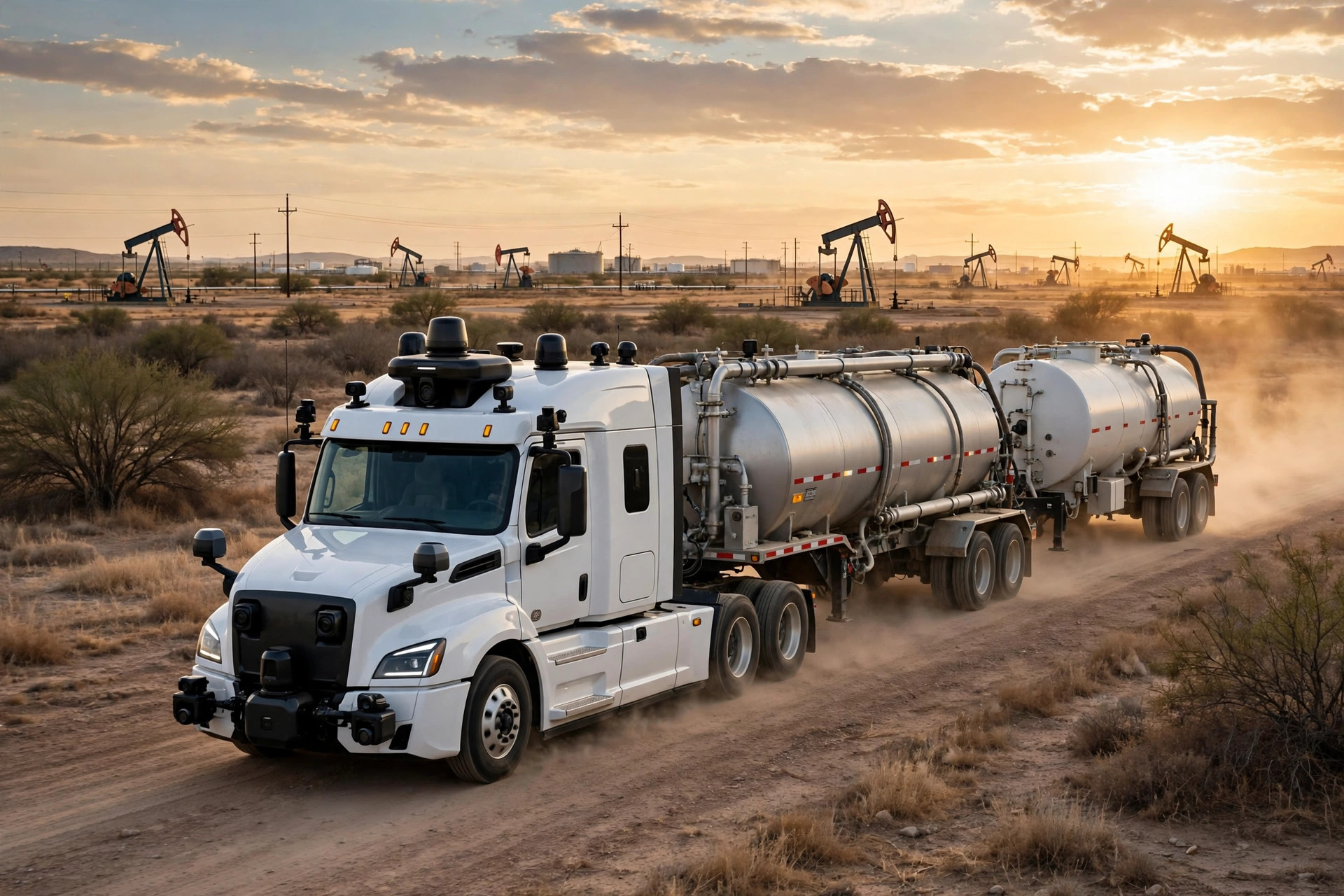
Image: Illustration: AI-generated by CDLWire
Kodiak AI has delivered the first two Western Star 49X trucks equipped with its seventh-generation Kodiak Driver autonomous system to Atlas Energy Solutions, and the trucks are the first day-cab autonomous trucks deployed into commercial service, according to Commercial Carrier Journal on Nov. 5. The delivery, made in September and announced this week, is the first step in a 65-truck Western Star tranche inside Atlas's initial order of 100 Kodiak-equipped driverless trucks for Permian Basin oilfield work.
The two driverless trucks build on the companies' collaboration in the Permian Basin, and Kodiak is on track to complete Atlas's initial 100-truck order in the first half of 2027. Atlas's Western Star trucks are the first vehicles equipped with Kodiak's seventh-generation, or Gen7, hardware platform. Kodiak said Gen7 is more compact, provides nearly 50% more compute power than Gen6, and — on the company's stress testing — its SensorPods and compute enclosures are expected to have nearly 50% greater operational lifetimes than prior generations. “These developments all serve to showcase Kodiak's relentless focus on providing solutions that deliver value for our customer,” said Don Burnette, founder and CEO of Kodiak. “The Western Star 49X is an outstanding platform, and well suited for increasing durability and reliability in an unsupervised driverless operation like no other.”
Atlas framed the purchase the way its customers would: as a capacity answer. “Uptime is everything in our operation, so reliability and performance are what we look for in every truck,” said John Turner, CEO and President of Atlas Energy Solutions. “With driver shortages constraining the industry's ability to deliver, our growing fleet of autonomous vehicles, powered by Kodiak's seventh-generation hardware, gives Atlas a real advantage in serving Permian oil and gas producers. We expect the Western Stars to help us deliver proppant predictably as we add the remainder of the trucks in our initial 100 truck order through mid-2027.” The Gen6 platform the new hardware replaces had already posted the durability result Kodiak keeps citing: a driverless truck equipped with the Kodiak Driver operated for a record 64 consecutive days of continuous uptime, never powering off or restarting, between June 30 and Sept. 1. TruckingInfo, in an account updated Nov. 4, added that as of June 30 Atlas owned and operated 35 Kodiak-equipped driverless trucks, the fleet had accumulated more than 40,000 hours of paid driverless operation, and five additional trucks exceeded 45 consecutive days of uptime.
The oilfield fleet is only one of three Kodiak fronts now moving at once. The second is a highway fleet deal: Kodiak has signed a binding agreement to equip 75 DTL Transport trucks with its autonomous system, announced Oct. 28 and reported by TruckingInfo. California-based DTL will own and operate the trucks and pay Kodiak a per-mile fee for the technology — a structure Kodiak described as the first publicly announced definitive agreement by an interstate trucking carrier to operate driverless trucks within its own fleet under a driver-as-a-service model. DTL specializes in cross-country team runs and hauls produce for major grocery customers; its initial driverless routes are planned between Dallas and El Paso and between Dallas and Atlanta, with additional lanes to follow, and no deployment schedule for the 75 trucks was specified. A September pilot hauling perishable goods for DTL between Fresno and Los Angeles ran under a California testing permit with a safety driver, separate from the planned driverless service.
The third front is the launch everything else is timed against. Kodiak plans to begin commercial driverless highway service before the end of 2026, hauling IKEA freight with no one in the cab on a 219-mile segment, primarily along Interstate 45, between its Houston- and Dallas-area facilities — part of an existing 292-mile route connecting IKEA's distribution center in Baytown, Texas, with its store in Frisco. The companies have hauled more than 1,300 IKEA loads and logged more than 750,000 miles over four years with a safety observer aboard. The launch remains contingent on completing Kodiak's safety case, its documented argument that the system can operate safely within a defined operating environment. On Oct. 30 Kodiak reported progress on that safety case at 99%, up from 96% at the end of September and 93% in early September — a measure of completed claims and evidence, not of driving situations handled. Kodiak has also begun hauling for Charger USA on a 435-mile Dallas–Laredo lane, its first serving the Laredo gateway, with a safety driver aboard for now.
For drivers, the honest read is narrower than the headlines. The trucks entering service first are day cabs hauling proppant on repetitive Permian Basin oilfield routes, and the highway launches are single Texas lanes, gated on an unfinished safety case, with regulatory pieces still being fitted: FMCSA has granted Aurora and Kodiak a five-year exemption, effective Oct. 7, allowing driverless trucks to use cab-mounted warning beacons instead of reflective triangles, and a PrePass–Kodiak system announced in September will let enforcement verify Enhanced Inspection information for bypass decisions. No carrier has announced a driverless replacement for ordinary over-the-road work, and DTL keeps owning and operating its trucks. What is changing is the order book: 100 trucks for Atlas, 75 for DTL and a named launch shipper in IKEA mean autonomous capacity is being bought in fleet quantities for specific lanes. Drivers running Texas oilfield, Permian and Dallas–Houston freight should watch those lanes first.
Sources
Related coverage
 November 4, 2026 · EquipmentClass 8 truck orders plunge in October — FTR counts 15,600, down 36%, and ACT counts 13,500, down 45%, as EPA 2027 uncertainty freezes fleet buying
 October 30, 2026 · EquipmentNHTSA starts the first major tire-standard overhaul in more than 20 years — and the bias-era tests may not survive it
 October 27, 2026 · EquipmentPilot and Tesla open their first two heavy-duty truck charging sites — Ellabell, Georgia and Tulare, California
Comments
Loading comments…